

![[2025 MOE USR Co-Learning] TMU Leads SROI Practice](/userfiles/images/20251009180308153.JPG)

Shuang Ho Hospital Advances Medical ESG and Low-Carbon Transformation, Cuts Carbon Emissions by More Than 10% in Three Years, an
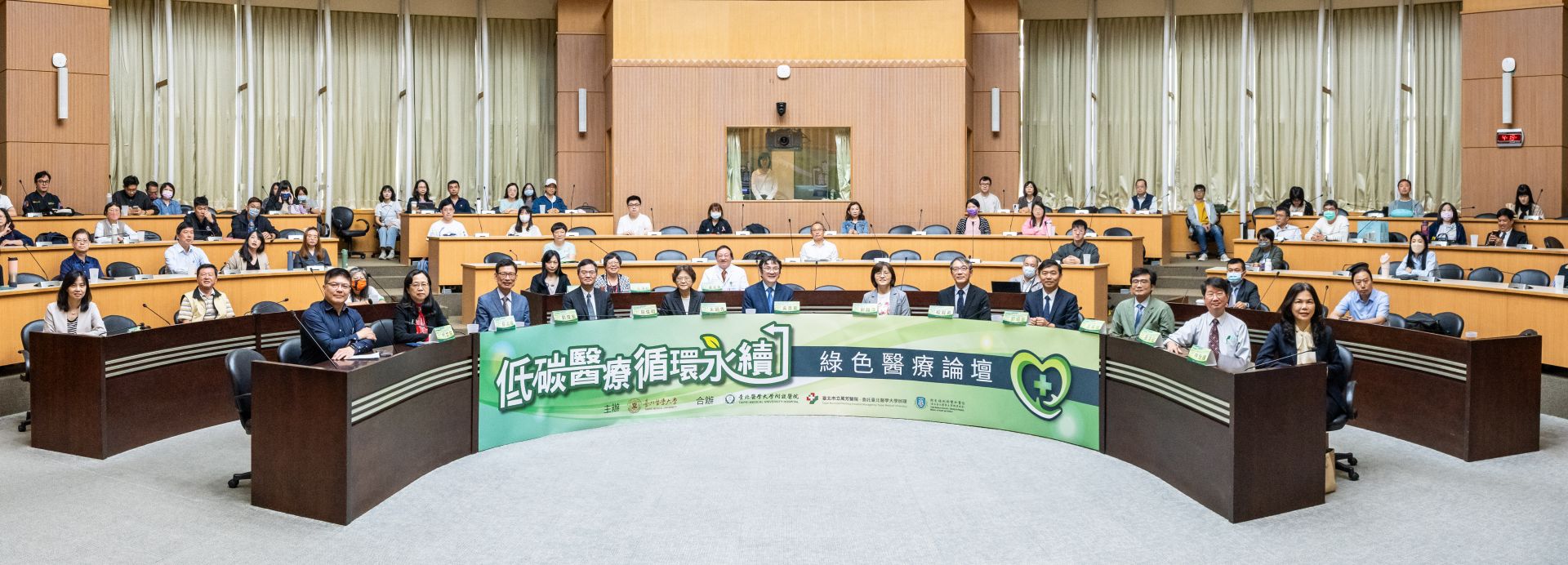
Amid the global momentum toward net-zero emissions and sustainable governance, healthcare systems are also stepping up decarbonization efforts. On March 17, 2026, Shuang Ho Hospital announced that it had joined hands with Taipei Hospital, Ministry of Health and Welfare; Keelung Hospital, Ministry of Health and Welfare; Chung Ying Hospital; and Ban Ying Hospital to establish the “Sustainable Healthcare Alliance.” In collaboration with the Industrial Technology Research Institute (ITRI), the alliance will promote healthcare decarbonization and ESG governance. Shuang Ho Hospital stated that since launching its sustainability policy in 2022, the hospital has reduced its carbon emissions by more than 10% over three years. The alliance was formally launched under the witness of the Ministry of Environment and the Ministry of Health and Welfare, with the aim of creating a demonstration model for the low-carbon transformation of Taiwan’s healthcare system.
 Deputy Minister Yeh Chun-hung of the Ministry of Environment noted that the healthcare system is one of society’s key critical infrastructures and also an energy-intensive service sector, making it highly significant in the context of net-zero goals. With government policy guidance and proactive action by healthcare institutions, cross-hospital collaboration can help establish more systematic carbon management and energy governance models, thereby driving the healthcare sector toward low-carbon transformation.

Deputy Director-General Liu Yu-ching of the Department of Medical Affairs, Ministry of Health and Welfare, stated that climate change has made sustainable development a major issue for healthcare systems worldwide. The ministry is currently strengthening hospitals’ sustainability governance capacity through the Healthy Taiwan Deep Cultivation Plan and promoting greenhouse gas inventories and carbon management in medical institutions. It also plans to gradually incorporate sustainability-related indicators into the hospital accreditation system in the future, encouraging hospitals to move toward the model of green hospitals. She added that Shuang Ho Hospital’s integration of medical and technological resources to establish the Sustainable Healthcare Alliance has strong demonstration value for Taiwan’s healthcare sustainability transition.
Chen Li-wei, Executive Director of ITRI’s Industrial Service Center, said that hospitals operate around the clock, making them energy-intensive and creating a strong need for decarbonization. ITRI will leverage its long-term experience in energy management and sustainability governance to assist hospitals through smart energy management systems, carbon hotspot analysis, and a sustainable carbon management platform, helping them identify sources of emissions and establish systematic carbon governance mechanisms so that technology can become a key enabler of healthcare decarbonization.
 Superintendent Li Ming-che of Shuang Ho Hospital emphasized that hospitals are responsible not only for safeguarding public health, but also for advancing social sustainability. He noted that sustainable healthcare cannot be achieved in isolation; only through cross-hospital cooperation and resource integration can its impact truly be expanded. In recent years, Shuang Ho Hospital has promoted the concept of “One Department, One Sustainability Initiative,” encouraging each department to implement sustainability actions through workflow optimization, energy management, and resource circularity, so that ESG becomes not just an idea but a concrete part of everyday medical practice. Through the establishment of the Sustainable Healthcare Alliance, the hospital also hopes to play the role of a medical center that supports smaller regional and district hospitals, sharing its accumulated sustainability governance experience and management model to strengthen their carbon and energy governance capacity while maintaining healthcare quality.
Vice Superintendent Wu Mei-yi also shared the hospital’s recent achievements in green healthcare transformation. Since launching its sustainability policy in 2022, the hospital had reduced carbon emissions by more than 10% by 2025. Its medical waste reuse rate reached 18.2%, outperforming the healthcare industry average of about 14%. Recycled plastic medical waste produced within the hospital was turned into recycled cleaning bags and biohazard waste bags, which received environmental labels in 2024 and early 2026, respectively. The hospital has also completed 11 carbon footprint inventories, leading healthcare institutions nationwide. For example, the carbon footprint of each hemodialysis treatment is 7.754 kgCO₂e, and through its Green Kidney Project, the hospital estimates an annual carbon reduction of about 363,076 kgCO₂e. Going forward, these efforts will be expanded to more clinical units, integrating value-based care with low-carbon healthcare models to gradually realize the core values of sustainable healthcare.
In the future, the Sustainable Healthcare Alliance will continue to promote actions in energy management, carbon inventories, the circular economy, and talent development through cross-hospital collaboration and experience sharing, with the goal of building a replicable model for sustainable healthcare governance. In addition to the alliance member hospitals, representatives from New Kuo Min Hospital, Taipei Medical University Hospital, and Wan Fang Hospital also joined this event for exchange and discussion. Through government policy guidance, healthcare system collaboration, and the introduction of technological innovation, the initiative aims to help Taiwan’s healthcare system move toward a more resilient and sustainable future.