
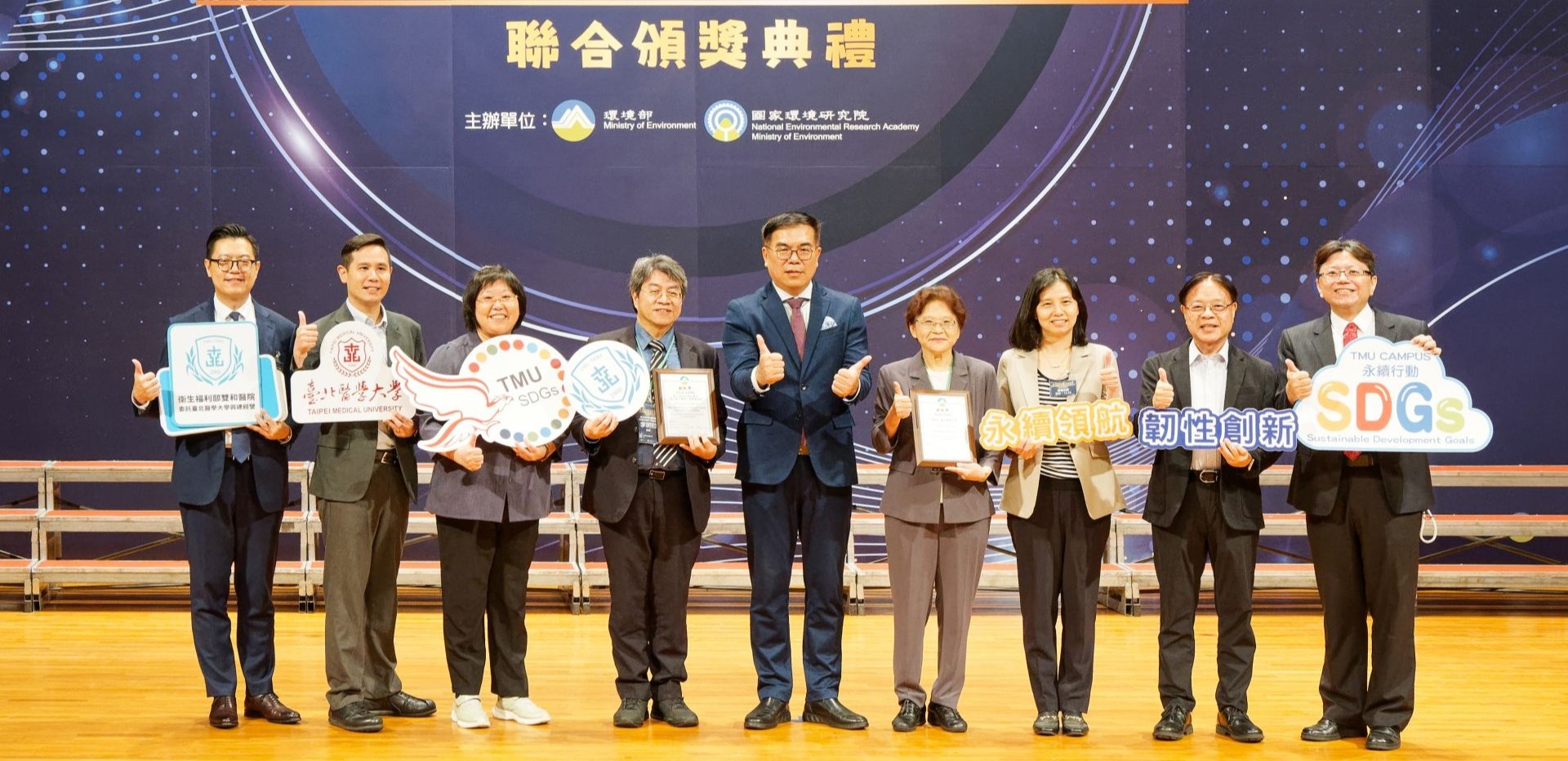
![[2025 MOE USR Co-Learning] TMU Leads SROI Practice](/userfiles/images/20251009180308153.JPG)

TMU Hosts MedZero International Symposium, Bringing Together Asia's Low-Carbon Healthcare and Resource Circulation Efforts
International experts and healthcare leaders share practical insights on climate resilience, digital transformation, and clinical decarbonization
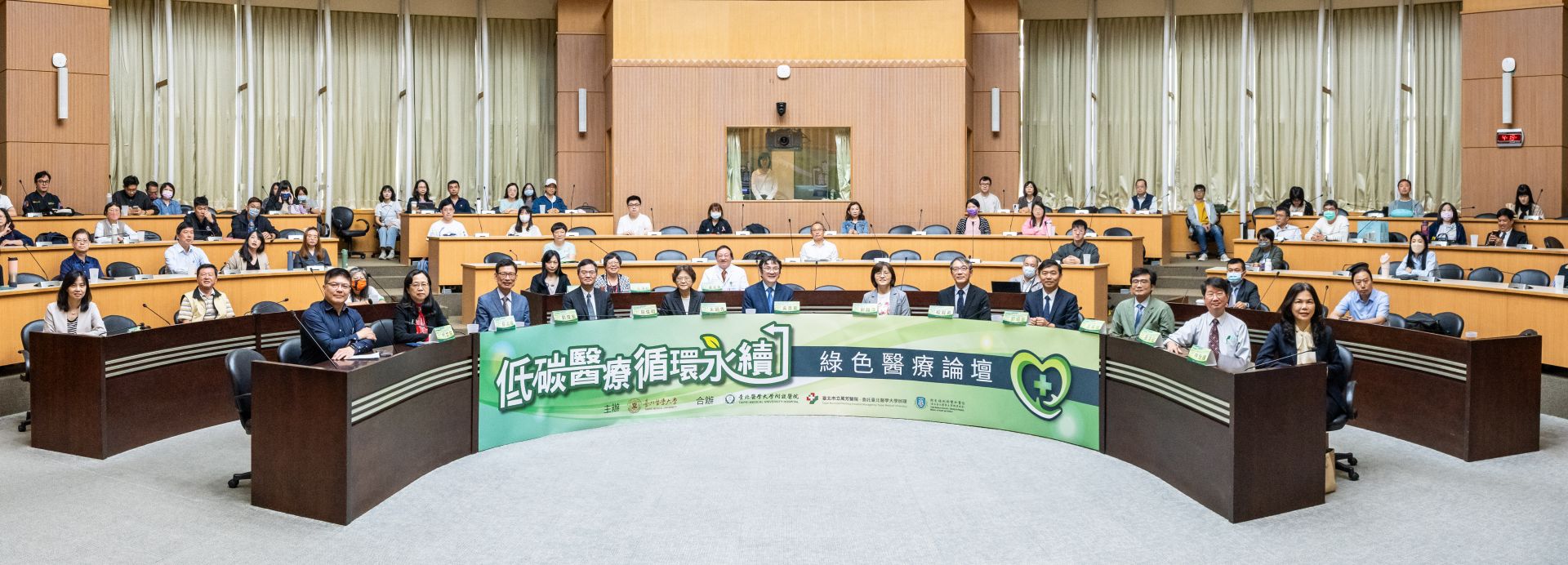
On September 16, 2026, Taipei Medical University (TMU) hosted the "MedZero: Reshaping the Global Healthcare Ecosystem" international symposium at the Cheng Pu Auditorium in the Medical Complex Building. The event brought together international sustainable healthcare experts, government representatives, and leaders of Taiwan's healthcare institutions to exchange transformation strategies and practical experience in climate resilience, low-carbon care, digital transformation, and resource circulation. The opening ceremony featured remarks by TMU President Mai-Szu Wu, Director-General Liu Yueh-Ping of the Department of Medical Affairs, Ministry of Health and Welfare, and Deputy Director-General Hsu Chih-Lun of the Resource Circulation Administration, Ministry of Environment, launching a full day of programming.
(1).jpg)
Group photo of the MedZero International Symposium
%20ps.jpg) | %20ps2.jpg) |
Director-General Liu Yueh-Ping of the Department of Medical Affairs, Ministry of Health and Welfare (left), and Deputy Director-General Hsu Chih-Lun of the Resource Circulation Administration, Ministry of Environment (right), deliver remarks to open the day's program.
International Experts Examine Climate Risks and Action Gaps in Asian Healthcare
The first keynote, "Assembling Building Blocks for Sustainable Healthcare in Asia," was delivered by Professor Nick Watts, Director of the Centre for Sustainable Medicine at the National University of Singapore, who outlined the climate risks and action gaps facing healthcare systems across Asia. He noted that in Southeast Asia, one in five hospitals faces the risk of full or partial shutdown due to climate change, and that while most healthcare workers in the region support stronger climate action, they still lack the tools, training, and clear policies to act. Professor Watts recommended that healthcare institutions immediately pursue evidence-based actions that benefit both patients and operational efficiency, while building the investment case and developing sustainability capacity among organizations and frontline staff. Related research indicates that sustainable healthcare initiatives have an estimated payback period of about 3.6 years.
.jpg) | .jpg) |
Professor Nick Watts, Director of the Centre for Sustainable Medicine at the National University of Singapore (left), shares the climate risks and action gaps facing Asian healthcare systems; Ruth Stringer, Science and Policy Coordinator at Health Care Without Harm (right), examines the links between medical waste, plastic use, and climate impact.
The second keynote, "Medical Waste, the Plastics Crisis and Circularity in Healthcare," was delivered by Ruth Stringer, Science and Policy Coordinator at Health Care Without Harm, who explored the connections between medical waste, plastics use, and climate impact. She noted that supply chains account for roughly 70% of the healthcare sector's carbon footprint, meaning that beyond improving on-site energy use, healthcare institutions must also address procurement, product design, reuse, recycling, and final disposal, advancing circular transformation guided by principles of waste reduction, phasing out incineration, reducing hazardous substances, protecting worker safety, and ensuring transparency. President Mai-Szu Wu then moderated the panel "From Global Vision to Action in Asia" with Stringer and Dr. Agnes Henson, Research Fellow at the Centre for Sustainable Medicine at the National University of Singapore, discussing supply chain decarbonization, clinical alternatives, and the enabling conditions for action across Asian countries.
.jpg) | .jpg) |
President Mai-Szu Wu moderates the panel "From Global Vision to Action in Asia," joined by Ruth Stringer and Dr. Agnes Henson, Research Fellow at the Centre for Sustainable Medicine at the National University of Singapore.
Low-Carbon Care and Digital Transformation Strengthen Healthcare Resilience
The afternoon session on "Healthcare Sustainability and Resilience" was chaired by TMU Vice President Cheng Yi-Chun. Superintendent Shih Chun-Ming of Taipei Medical University Hospital shared TMU's integrated sustainability governance and talent development mechanisms across campus and hospitals, and described how the "1 Department, 1 ESG" initiative has each clinical department review its processes, consumables, medical gases, and energy and resource use, folding patient safety, care quality, and low-carbon care into a single decision-making framework. The hospital is also embedding sustainability into daily clinical operations through enhanced recovery care, medical gas usage guidelines, carbon footprint assessments of medical services, and waste sorting and recycling.
.jpg) | .jpg) |
TMU Vice President Cheng Yi-Chun (left) chairs the "Healthcare Sustainability and Resilience" session; Superintendent Shih Chun-Ming of Taipei Medical University Hospital (right) shares TMU's integrated sustainability governance and talent development mechanisms.
Superintendent Lee Kang-Yuan of Wan Fang Hospital approached the topic through artificial intelligence and digital transformation, explaining how healthcare institutions can improve care efficiency while reducing unnecessary resource use. Using the rural AIoT smart dialysis program at Hsin Kuo Min Hospital and the dialysis center in Fuxing District, Taoyuan as an example, contactless sensing, AI risk prediction, real-time alerts, and remote specialist support address challenges such as patients traveling over 86 kilometers round trip per visit and shortages of specialist staff in rural areas. Workflow improvements combining barcodes with a digital pathology system also save about 1,280 working hours and 1,040 sheets of paper each year.
Superintendent Cheng Shun-Ping of Taipei Hospital, Ministry of Health and Welfare, shared the hospital's integrated results in smart healthcare and green transformation. The hospital is advancing building energy management, smart care, surgical plastic reduction, low-carbon meals, and medical waste management in parallel. Its green dialysis center, which adopted automated dialysis data integration, paperless laboratory testing, and reverse osmosis wastewater recovery, reduced emissions by a combined 79,732 kilograms of CO2 equivalent across these three measures and completed ISO 14064-1 greenhouse gas inventory verification.
.jpg) | .jpg) |
Superintendent Lee Kang-Yuan of Wan Fang Hospital (left) explains how AI and digital transformation can improve care efficiency while reducing unnecessary resource use; Superintendent Cheng Shun-Ping of Taipei Hospital, Ministry of Health and Welfare (right), shares integrated results in smart healthcare and green transformation.
Life Cycle Assessment and Resource Circulation Deepen Clinical Practice
The "Circular Economy in Healthcare" session was chaired by TMU Vice President Chu Chuan-Hsiu. Chief Sustainability Officer Chien Ling-Chu of TMU used life cycle assessment methods to analyze the carbon footprint and environmental impact hotspots of health checkups, cataract surgery, and endoscopy. The research shows that energy and medical consumables are major sources of impact. In a simulated scenario integrating endoscopic ultrasound and endoscopic retrograde cholangiopancreatography workflows, most environmental impact categories could be reduced by roughly 30%, showing that process integration can reduce duplicate procedures while balancing care quality and environmental benefits.
.jpg) | .jpg) |
TMU Vice President Chu Chuan-Hsiu (left) chairs the "Circular Economy in Healthcare" session; TMU Chief Sustainability Officer Chien Ling-Chu (right) uses life cycle assessment to analyze the carbon footprint and environmental impact hotspots of health checkups, cataract surgery, and endoscopy.
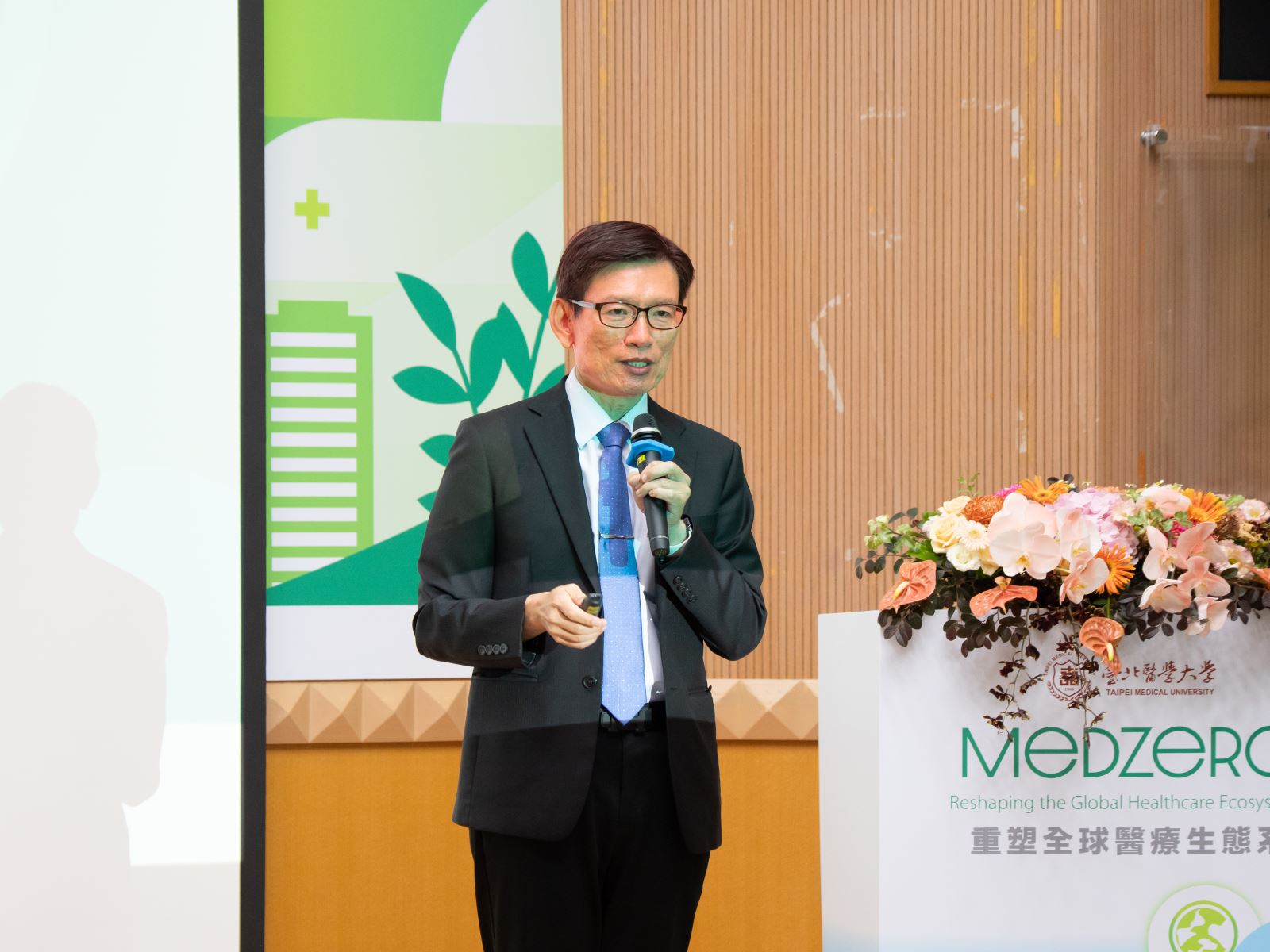
Superintendent Liu Tsan-Hung of Shuang Ho Hospital, Ministry of Health and Welfare, shared results in dialysis unit waste reduction and water conservation. Shuang Ho Hospital is the first hospital in Taiwan whose hemodialysis services have received third-party verification for both ISO 14067 carbon footprint and ISO 14046 water footprint. From January to August 2026, the reuse rate of medical plastic waste in the hemodialysis unit rose steadily, reaching 39.6% in August, with a cumulative 22.4 metric tons reused. The hospital also recycles reverse osmosis process wastewater for toilet flushing and air-conditioning cooling, recovering 16,341.9 cubic meters in 2025, a recovery rate of 60.4%, reducing both water use and waste treatment loads.
Dr. Wu Che-Hsiung, Deputy Chief Sustainability Officer at Taipei Tzu Chi Hospital, presented "From Green Wards to Net-Zero Transformation," proposing the hospital ward as the smallest viable unit for low-carbon transformation. A ward covers a continuous care process including medication, testing, meals, cleaning, and waste, and can establish indicators for electricity, water, paper, linens, and waste, making it a suitable starting point for cross-professional teams to improve together. Taipei Tzu Chi Hospital uses 2024 as its baseline year, targeting 30% emissions reduction by 2030, 70% by 2040, and 90% by 2050, with carbon sinks offsetting remaining emissions.
 | .jpg) |
Superintendent Liu Tsan-Hung of Shuang Ho Hospital (left) shares results in dialysis unit waste reduction and water conservation; Dr. Wu Che-Hsiung, Deputy Chief Sustainability Officer at Taipei Tzu Chi Hospital (right), presents "From Green Wards to Net-Zero Transformation," proposing the ward as the smallest viable unit for hospital low-carbon transformation.
Cross-Sector Collaboration Advances Taiwan's Healthcare Sustainability Transition
The symposium closed with a roundtable moderated by Vice President Cheng Yi-Chun, featuring Superintendent Shih Chun-Ming, Superintendent Liu Tsan-Hung, Chief Sustainability Officer Chien Ling-Chu, and Deputy Chief Sustainability Officer Wu Che-Hsiung, who discussed next steps for Taiwan's healthcare system in governance structures, clinical engagement, data inventories, and cross-sector collaboration.
TMU stated that healthcare sustainability must simultaneously address patient safety, care quality, operational resilience, and environmental responsibility. By connecting international trends with Taiwan's clinical practice, the symposium fostered exchange among healthcare institutions, government, and academic and research organizations. TMU will continue to combine the research and practical strengths of its "One University, Three Hospitals" system and partners to advance measurable and replicable low-carbon healthcare and resource circulation solutions, building concrete experience for the sustainable transformation of Asia's healthcare systems.
.jpg)
Vice President Cheng Yi-Chun moderates the closing roundtable with Superintendent Shih Chun-Ming, Superintendent Liu Tsan-Hung, Chief Sustainability Officer Chien Ling-Chu, and Deputy Chief Sustainability Officer Wu Che-Hsiung, discussing next steps for Taiwan's healthcare system in governance, clinical engagement, data inventories, and cross-sector collaboration.